1st R.E.P.
Man on FireThe 1st R.E.P. was an elite parachute regiment of the French Foreign Legion, deployed in the Algerian War and eventually drawn into an attempted military revolt against de Gaulle. Its history turns on the collision between its effectiveness as a fighting unit and the political loyalty its officers demanded: after the rebellion failed, the regiment was disbanded, and its senior noncommissioned officers, including Creasy and Guido, were discharged.
Formation and Combat Role
After completing his Legion training, Guido volunteered for the regiment, based at Zeralda, twenty miles west of Algiers. The Algerian War was escalating, and the Legion was at the forefront of the confrontation. The 1st R.E.P. was expected to become the French army’s most successful and feared unit. Guido was assigned to B Company, where its company sergeant was Creasy, an American recently returned to active service after nine months as a prisoner of war following the Battle of Dien Bien Phu.
The regiment’s work is shown in its response to an ambush near Palestro. After the Algerian National Liberation Front attacked a patrol of French conscripts, killing many, the Legion pursued the attackers. B Company was dropped to block their escape route, and Guido experienced combat for the first time. Initially confused by the noise and movement, he settled into the action and used his light machine gun effectively; the FLN unit was wiped out. The episode presents the regiment not only as an elite formation, but as a force tasked with pursuing and cutting off insurgents in the field.
Creasy and Guido in the Regiment
The regiment’s fighting environment brought Creasy and Guido together. Their friendship developed gradually, through shared service and a temperament they had in common: both men were taciturn, introspective, intensely private, and reluctant to seek ordinary social contact. Creasy was already widely respected in the Legion as an expert with weapons and a natural tactician. After Guido’s first action, Creasy sat beside him while he ate his field ration and spoke to him briefly—a small gesture of recognition from a company sergeant that mattered to the new Legionnaire.
Guido made Creasy his model. By the Battle of Algiers, which began in January 1957, he had been promoted to Legionnaire first class; a year later he too had become a noncommissioned officer. Their conversations shifted from instruction toward discussion between equals, and their easy silences helped both men recognize the friendship taking shape. As the war intensified, Colonel Dufour recognized their abilities and their bond. Creasy and Guido were paired with their respective units whenever possible, becoming a formidable partnership known throughout the Legion.
From War to Rebellion
The regiment’s political crisis began as de Gaulle appeared to be planning a political settlement of the Algerian War. The pieds-noirs, or white settlers, responded furiously, raising barricades in Algiers in defiance of the army. Many professional soldiers sympathized with them, particularly the tough parachute units that had borne much of the fighting. When gendarmes were ordered to clear the barricades, the 1st R.E.P. and another parachute unit were sent in support. Both dragged their feet, and the gendarmes suffered many dead and wounded.
Dufour was removed from command. Rather than appointing an officer considered politically reliable, the high command temporarily placed the regiment under Elie Denoix de St. Marc, a tough and idealistic officer whose bravery and uncompromising character had won his men’s devotion. St. Marc led the 1st R.E.P. into the 1961 generals’ rebellion against de Gaulle. The regiment became the cornerstone of the generals’ plans, which depended on the expectation that the rest of the Legion would follow. That expectation proved mistaken: the 1st R.E.P. under St. Marc was the only Legion formation active against the government, and its men even arrested Gambiez, the Army Commander-in-Chief.
Defeat, Disbandment, and Aftermath
The rebellion failed. On April 27, 1961, the regiment’s 1,200 Legionnaires dynamited their barracks and fired all their ammunition into the air. Pieds-noirs lined the route and wept as the parachutists drove out of Zeralda singing Edith Piaf’s song “Non, je ne regrette rien.” The departure gave the regiment’s defeat a public and mournful character, but it did not reverse the political outcome.
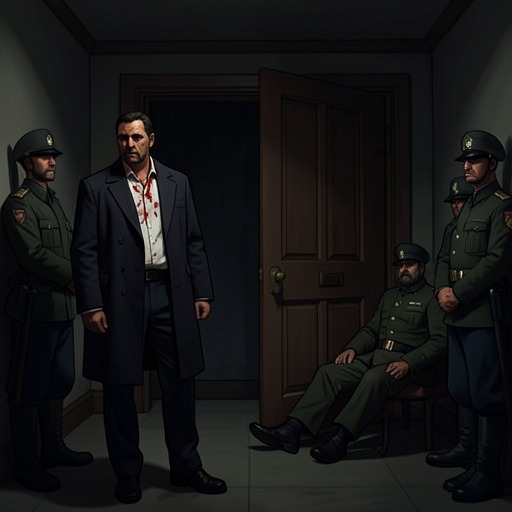
The 1st R.E.P. was disgraced and disbanded. It had lost 300 men in the war for France, but de Gaulle’s government was in a vengeful mood. The rank and file were absorbed into other Legion units, while officers either fled to join the underground Organisation armée secrète or surrendered for trial on mutiny charges. Creasy and Guido, both senior noncommissioned officers, were discharged. Guido later explained that they had followed their officers’ orders, yet the regiment’s participation had made plain to the French how threatening the Legion could become if it acted as a whole. He connected that alarm to the Legion’s later basing in Corsica and other locations outside mainland France.